Orange County Home Insurance Surge — Wildfire Impact and Cost-Reduction Strategies

If you own a home in Orange County in 2026, you've probably been caught off guard by your insurance renewal notice. Even in areas like Irvine — far removed from direct wildfire risk — residents are reporting premium increases of over 22% in online communities. In this post, we break down why rates have skyrocketed, and what Orange County homeowners should do right now, backed by real market data. With the information in this guide, you can find practical ways to cut hundreds of dollars off your annual premium.
The January 2025 LA Wildfires — How Bad Was It?
On January 7, 2025, the Palisades Fire and the Eaton Fire broke out simultaneously in Pacific Palisades and Altadena, making them among the costliest natural disasters in California history. Combined, the fires burned approximately 50,000 acres (about 202 km²) and destroyed nearly 16,000 structures. The official death toll stands at 31, but a joint research team from Boston University and the University of Helsinki published findings in JAMA (August 2025) estimating that the true death toll — including indirect causes such as smoke exposure, air pollution, and disrupted medical access — exceeded 440.
The economic damage is even more staggering. Munich Re tallied total losses at $53 billion, with insured losses alone reaching $40 billion. That makes it the single most costly wildfire event in U.S. history. The FAIR Plan (California's insurer of last resort) received roughly $4 billion in claims — a burden that ultimately gets passed on to all California homeowners with insurance policies.
How Much Have California Home Insurance Rates Gone Up?
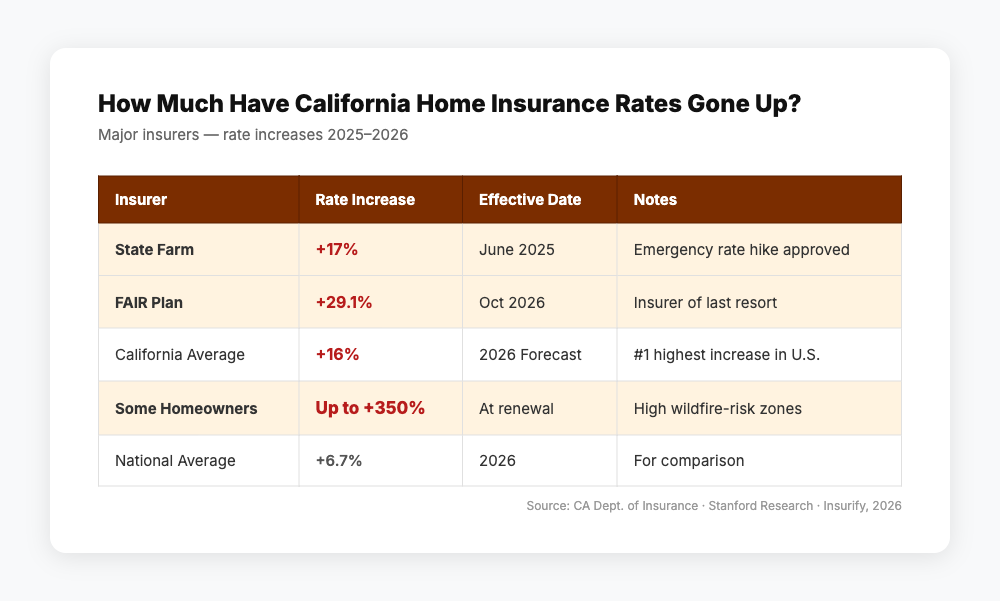
Through 2023, California's median home insurance premium was around $1,200 per year — roughly in line with the national average. But starting in 2025–2026, the state has surged to the top nationally in rate increases.
A look at individual insurer actions tells the story clearly:
- State Farm: Filed an emergency 22% rate increase (February 2025) → approved at 17% emergency rate (effective June 2025). Despite being California's largest home insurer, it had already halted new policy issuance since 2023.
- Allstate: Filed and received approval for a 34.1% rate increase (reported by the LA Times, August 2024).
- FAIR Plan: An average 29.1% increase is scheduled for October 15, 2026. The plan originally requested 35.8%, which the California Department of Insurance (CDI) adjusted down to 29.1%. Roughly 4 out of 5 affected policies are expected to see increases of 5–60%.
- California overall in 2026: Insurify projects an additional increase of up to 16% — four times the national average of 4%.
According to Matic data, the average premium for new policies already reached $1,952 in 2024–2025. For high-risk properties near hillsides or canyons, renewal increases of several hundred percent have been reported.
Is Orange County — and Irvine — Safe from This?
"I'm in Irvine, so this doesn't really apply to me, does it?" That's a question we hear often. From direct conversations with buyers and sellers in the field, it's clear that insurance costs are increasingly influencing purchase decisions.
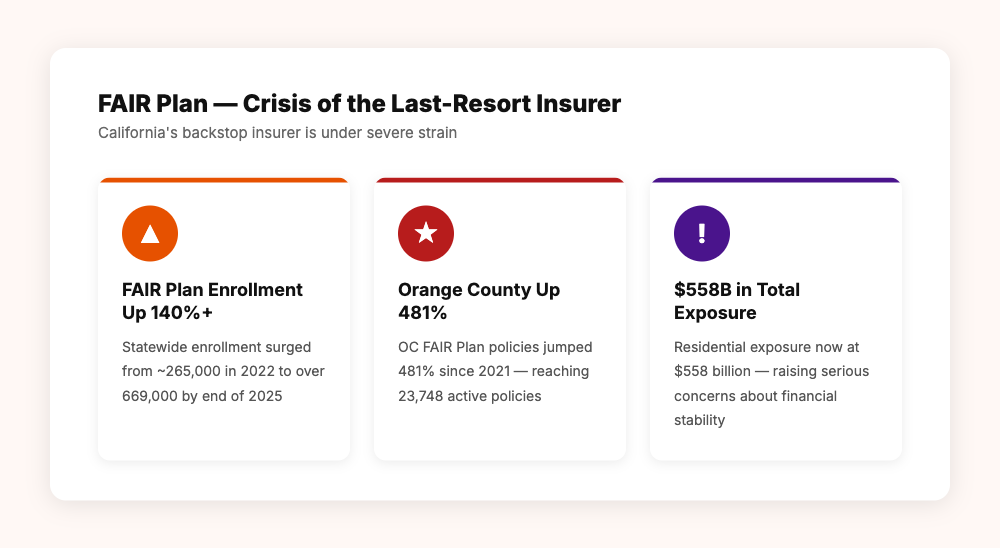
FAIR Plan enrollment in Orange County has surged 481% since 2021, reaching 23,748 policies — one of the highest growth rates in the nation. In September 2024, the Airport Fire directly affected parts of Orange County, prompting the CDI to issue a moratorium on non-renewal notices.
Irvine is classified as relatively low-to-moderate wildfire risk, but it has not been immune to rate increases. Based on resident reports confirmed on the Reddit r/orangecounty community, some Irvine condo owners saw premiums rise approximately 22% from 2025 to 2026. Areas with lower wildfire risk like Irvine may see smaller increases than high-risk FAIR Plan zones, but they are not fully insulated from broader market pressures.
FAIR Plan — The Limits of the Insurer of Last Resort
As private insurers continue to exit California, many homeowners are being pushed onto the FAIR Plan. Established under California state law as a de facto insurer of last resort, the FAIR Plan provides fire-focused coverage to homeowners who cannot obtain insurance in the private market.
Total FAIR Plan enrollment grew from approximately 265,000 policies in 2022 to 669,000 as of December 2025 — more than doubling in just over two years. Over the same period, residential exposure jumped from $160 billion to $558 billion — nearly 3.5 times higher in four years.
However, the FAIR Plan has structural limitations. Coverage is capped at $3 million, and it does not include theft or liability protection. As a result, many FAIR Plan policyholders must purchase a separate "wrap-around" policy to fill those coverage gaps.
On July 2, 2026, the Los Angeles County Superior Court ruled that the wildfire surcharge (FAIR Plan assessment) is legally valid. This means all California homeowners with insurance — regardless of whether they live in a wildfire-risk area — must now pay a median annual surcharge of approximately $28. A total of 105 insurers have received CDI approval and are already applying the surcharge, including State Farm and Farmers.
5 Cost-Reduction Strategies You Can Use Right Now

Strategy 1 — Shop the Private Market Again and Exit the FAIR Plan
Starting in late 2025, some private insurers have been re-entering high-risk markets, including Orange County. Mercury General, CSAA Insurance Group, and Farmers Insurance are notable examples. Mercury General has stated a goal of absorbing 6.5% of FAIR Plan customers over eight years, and CSAA is already writing 18,300 policies beyond its mandated minimum. Since the FAIR Plan only covers fire — with no theft or liability — it's worth carefully comparing actual coverage and cost against private market alternatives.
Strategy 2 — Save Up to 24.5% with Home Hardening
Under the Safer from Wildfires regulations in effect since 2025, all admitted insurers are required to reflect home hardening improvements in their rates. The maximum discount structure under the FAIR Plan is as follows:
| Measure | Discount |
|---|---|
| Immediate Zone Zero defensible space clearance | Up to 5% |
| Structural hardening (Class A roof, ember-resistant vents, fire-resistant windows, etc.) | Up to 10% |
| Firewise USA community membership | Up to 10% |
| Maximum total | 24.5% |
Key actions include installing a Class A fire-rated roof, ember-blocking vents with 1/16-inch mesh, creating a 5-foot Zone Zero defensible space around the home, and using double-pane windows and fire-resistant siding. Discounts apply to the wildfire coverage portion only and require photo documentation and records of the work done.
Strategy 3 — Take Advantage of New 2026 Consumer Protections
Policies renewing from July 1, 2026 onward must now include a "building code upgrade" provision equal to 10% of the dwelling coverage limit. Additionally, when insurers use wildfire risk scores to set rates, homeowners now have the right to request the score, the underlying rationale, and steps they can take to improve it — in writing. Actively exercising this right at renewal time can translate into meaningful cost savings.
Strategy 4 — Get Comparison Quotes and Bundle Discounts
Use comparison platforms like Insurify, Policygenius, or The Zebra to get quotes from multiple insurers. Bundling your auto and home insurance with the same carrier can often yield a 10–15% discount. Raising your deductible to a higher level is also a practical way to lower your premium.
Strategy 5 — Verify Insurability Before Buying
If you're considering purchasing a home in Orange County, confirming that you can actually obtain insurance — and at what cost — before closing is no longer optional. In some areas, private insurers are declining to write new policies altogether, leaving the FAIR Plan as the only option. Insurance costs have become as significant a variable in true ownership cost as the purchase price itself.
The Outlook — When Will Things Stabilize?
CDI Commissioner Ricardo Lara told the California legislature in February 2026: "We are not out of the crisis. A structurally sound market is a three-to-five-year project." Stanford professor Michael Wara similarly assessed that "market distortions that started in high wildfire-risk areas have now spread to the general market" — and that near-term stabilization is unlikely without structural fixes.
There are some encouraging signs. The CDI has shortened its rate approval timeline from roughly 12 months to about 120 days, with a target of 60 days. FAIR Plan enrollment growth also slowed to under 4% in Q4 2025. If no major wildfires occur in 2026–2027, a gradual stabilization scenario appears plausible.
That said, structural risk factors — prolonged wildfire seasons driven by climate change, rising reinsurance costs, and construction cost inflation — remain unresolved. California's insurance market is likely to remain under watch for the foreseeable future.
As today's overview makes clear, Orange County's home insurance market entered a new phase starting in 2025–2026. Simply receiving your renewal notice and paying it is no longer good enough. By pursuing home hardening discounts, getting competitive quotes as private insurers re-enter the market, and leveraging new consumer protection laws, there are real opportunities to cut your premiums by hundreds of dollars right now.
If you need help navigating insurance rate increases or want to verify insurability before buying in Orange County, feel free to leave a comment or reach out — we're happy to walk you through the current landscape.